
ATD Blog
Mentoring vs Coaching: What's the Difference?
Fri Mar 26 2021

Content
Sometimes people use the words “ mentoring ” and “ coaching ” interchangeably, but they do not describe the same type of working relationship. Both coaching and mentoring share specific goals, including employee learning and career development that lead to peak performance and the realization of full potential . However, the definitions, focuses, roles, approaches, and tools of each are different .
Sometimes people use the words “mentoring” and “coaching” interchangeably, but they do not describe the same type of working relationship. Both coaching and mentoring share specific goals, including employee learning and career development that lead to peak performance and the realization of full potential. However, the definitions, focuses, roles, approaches, and tools of each are different.
Coaching vs. Mentoring
Content
Coaching and mentoring can both develop specific skills and improve performance. When deciding between coaching and mentoring, it is essential to evaluate what an individual’s desired personal and professional growth looks like. Knowing up front what the end goal is for an individual provides valuable insights into where their career path is headed and which professional development tools can help them get there.
Definition and Focus
Content
When it comes to coaching versus mentoring, think about what specific skills you want to grow. Some skills are better developed in mentoring programs while others require the intentional focus of coaching.
Content
Mentoring : An informal association focused on building a two-way, mutually beneficial relationship for long-term career movement. Mentoring drives engagement due to its interpersonal approach.
Mentoring: An informal association focused on building a two-way, mutually beneficial relationship for long-term career movement. Mentoring drives engagement due to its interpersonal approach.
Content
Coaching : The International Coaching Federation (ICF) defines coaching as “a partnering with clients in a thought-provoking and creative process that inspires them to maximize their personal and professional potential. The process of coaching often unlocks previously untapped sources of imagination, productivity, and leadership.”
Coaching: The International Coaching Federation (ICF) defines coaching as “a partnering with clients in a thought-provoking and creative process that inspires them to maximize their personal and professional potential. The process of coaching often unlocks previously untapped sources of imagination, productivity, and leadership.”
Role
Content
Mentoring: Talking with a person who has identified their needs before entering a mentoring relationship. The emphasis is on active listening, providing information, making suggestions, and establishing connections. A mentoring relationship may be more mutually beneficial than a coaching relationship.
Content
Coaching: Listening to a person, identifying what they need, and helping them develop an action plan. The emphasis is on the person or client finding the solution, not instructing or leading them. A coaching relationship puts the focus on one specific person within the arrangement.
Approach
Content
Mentoring: This is a self-directed modus operandi whereby participants have choices. This approach can begin with a self-matching process and continue throughout the relationship using a committed timeline to determine how often and where individuals will meet, identify goals, and so forth . Even with the informal structure, mentorship often takes the form of official mentorship programs.
Mentoring: This is a self-directed modus operandi whereby participants have choices. This approach can begin with a self-matching process and continue throughout the relationship using a committed timeline to determine how often and where individuals will meet, identify goals, and so forth. Even with the informal structure, mentorship often takes the form of official mentorship programs.
Content
Coaching: A structured modus operandi is more frequently used whereby participants work within a narrower perspective; their agenda is more specific, for a short period of time, and oriented toward certain results . Usually, a coach is assigned to an employee within an organization. Consistent coaching sessions can lead to stronger relationships between the coach and their client.
Coaching: A structured modus operandi is more frequently used whereby participants work within a narrower perspective; their agenda is more specific, for a short period of time, and oriented toward certain results. Usually, a coach is assigned to an employee within an organization. Consistent coaching sessions can lead to stronger relationships between the coach and their client.
Tools
Content
Mentoring: The most important tool is the Mentoring Agreement—developed, completed, and signed by both participants. This document formalizes the commitment to the mentor relationship. Items include individual goals, learning content, a meeting schedule, and communication methods.
Content
Coaching: A coaching agreement is used to set the ground rules for the partnership. Within organizations, 360 assessments sometimes precede the coaching sessions. Skills assessments are sometimes used depending on the nature of the coaching program. A strong coaching relationship is the basis of effective coaching.
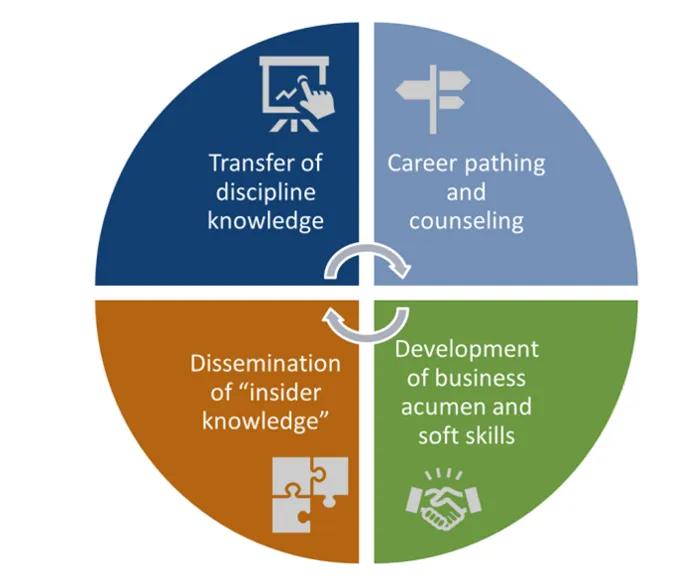
The Mentorship Cycle
Content
Learn more about mentoring partnerships from Creating a Mentoring Program , available now.
Learn more about mentoring partnerships from Creating a Mentoring Program, available now.
Similarities Between Coaching vs Mentoring
Content
Although differences exist between coaching and mentoring, they do share some comparable characteristics as well:
Content
Defined roles allow individuals to envision the achievement of desired goals.
Content
Working relationships require trust, respect, open communication, and flexibility.
Content
Stakeholders include new hires, new managers, and staff promoted to senior-level positions.
Content
Training, education, and orientation are necessary.
Content
Success is best achieved when senior leaders understand the return on investment, and expectations regarding engagement, performance, and retention are being met.
Content
The mission is to meet both individual and organizational goals.
Content
An organization is not required to choose between mentoring and coaching relationship . Each one enhances an individual’s ability to contribute to the organization’s goals . Even the focus on personal and professional development sets one up for success in their career. Consider how these two activities can fulfill the expectations of individuals, managers, and senior-level executives, while simultaneously accomplishing the organization’s employee development and succession planning goals. Additionally, consideration of the value these programs bring to the table and the benefits people expect to gain.
An organization is not required to choose between mentoring and coaching relationship. Each one enhances an individual’s ability to contribute to the organization’s goals. Even the focus on personal and professional development sets one up for success in their career. Consider how these two activities can fulfill the expectations of individuals, managers, and senior-level executives, while simultaneously accomplishing the organization’s employee development and succession planning goals. Additionally, consideration of the value these programs bring to the table and the benefits people expect to gain.
Virtual Coaching vs. In-Person
Content
Virtual coaching uses digital platforms (video, phone, messaging, and coaching apps) to deliver one-to-one or group coaching at scale. From a business perspective, it addresses cost, access, speed, and consistency—key constraints of traditional coaching models.
Content Dimension Dimension | Content Virtual Coaching Virtual Coaching | Content In-Person Coaching In-Person Coaching |
Content Cost Structure Cost Structure | Content Lower, predictable, scalable Lower, predictable, scalable | Content Higher, variable, travel-dependent Higher, variable, travel-dependent |
Content Reach Reach | Content Global, inclusive Global, inclusive | Content Local or regional Local or regional |
Content Speed to Deploy Speed to Deploy | Content Fast Fast | Content Slower Slower |
Content Flexibility Flexibility | Content High (shorter, more frequent sessions) High (shorter, more frequent sessions) | Content Lower (longer, scheduled sessions) Lower (longer, scheduled sessions) |
Content Data & Measurement Data & Measurement | Content Built-in analytics and tracking Built-in analytics and tracking | Content Often qualitative and manual Often qualitative and manual |
Content Relationship Depth Relationship Depth | Content Strong, but digitally mediated Strong, but digitally mediated | Content Often perceived as deeper face-to-face Often perceived as deeper face-to-face |
Content Best Use Cases Best Use Cases | Content Scaled leadership development, behavior change, performance support Scaled leadership development, behavior change, performance support | Content Executive coaching, high-stakes or highly sensitive engagements Executive coaching, high-stakes or highly sensitive engagements |
What Is a Coach?
Who Can Be a Coach in an Organization?
Content
A coach focuses on performance, development, and behavior change , typically through structured conversations and goal-setting rather than advice-giving.
A coach focuses on performance, development, and behavior change, typically through structured conversations and goal-setting rather than advice-giving.
Content
Internal Coaches
Internal Coaches
Content
These are employees trained to coach others:
Content
HR or L&D professionals with formal coaching training
Content
Managers using coaching skills (when coaching is not tied to evaluation)
Content
Internal certified coaches embedded within the organization
Content
Key requirement: They must maintain objectivity, confidentiality, and a non-evaluative stance .
Key requirement: They must maintain objectivity, confidentiality, and a non-evaluative stance.
Content
External Coaches
External Coaches
Content
These are professionals outside the organization:
Content
Executive coaches
Executive coaches
Content
Leadership or performance coaches
Content
Specialized coaches (for example, transition, resilience, career coaching)
Content
Why organizations use them:
Content
Higher neutrality
Higher neutrality
Content
Expertise with senior leaders
Content
Faster deployment for critical roles
What Qualifies Someone to Be a Coach
Content
From an organizational perspective, a coach should have:
Content
Formal coach training (internal program or external credential)
Content
Strong questioning, listening, and feedback skills
Content
Understanding of business context and organizational goals
Content
Clear ethical guidelines and boundaries
Content
Important distinction: Subject-matter expertise alone does not make someone a coach.
What Is a Mentor?
Who Can Be a Mentor in an Organization?
Content
A mentor focuses on career development, knowledge transfer, and organizational navigation , often by sharing experience and advice.
A mentor focuses on career development, knowledge transfer, and organizational navigation, often by sharing experience and advice.
Content
Typical Mentors
Typical Mentors
Content
Senior leaders or executives
Content
Experienced managers or technical experts
Content
High-performing employees with institutional knowledge
Content
Mentors are usually:
Content
Voluntary participants
Content
Matched based on experience, role, or career path
Content
Focused on long-term growth rather than short-term performance goals
What Qualifies Someone to Be a Mentor
Content
A mentor should have:
Content
Relevant experience in the organization or industry
Content
Credibility and trust
Content
Willingness to share insights, lessons learned, and networks
Content
Ability to sponsor, advocate, or open doors when appropriate
Content
Unlike coaching, mentoring does not require formal certification.
Can the Same Person Be Both?
Content
Yes, but not at the same time in the same relationship.
Content
Best practice is to:
Content
Clearly define the role at the outset.
Content
Avoid mixing coaching with performance evaluation.
Content
Train leaders on when to coach vs. when to mentor.
Content
Business Takeaway
Business Takeaway
Content
Coaching requires skill, neutrality, and structure.
Content
Mentoring requires experience, credibility, and generosity.
Content
High-performing organizations intentionally design both , using each where it delivers the greatest business value.
High-performing organizations intentionally design both, using each where it delivers the greatest business value.
Check out similar articles and resources to dive deeper into coaching and mentoring:
Content
Mentoring Is About Connection
Content
Mentoring and Coaching Can Develop Emotional Intelligence
Content
What Is Executive Coaching Glossary Page
Content
What Is Mentoring Glossary Page
Content
ATD’s Coaching Certificate
Content
Course Info: Evidence shows that coaching for individuals, teams, and organizations is a powerful development tool that leads to positive change and results. Earning the ATD Coaching Certificate improves your ability to help the people you coach develop rapidly, produce better results, improve their ability to achieve goals, and take action.
Content
What You’ll Gain: During this program, you will come to better understand yourself in the role of coach, uncovering your biases, strengths, and areas of development, so that you may refine your coaching approach for increased impact. The focus of this course is on practice, allowing you to quickly incorporate theories, models, and processes into your coaching conversations while receiving real-time feedback from your peers and an expert facilitator. You will leave this program better equipped to help individuals succeed by leveraging their natural strengths.
Content
This blog was originally published in August 2014 and has since been updated with new information and resources.