
CTDO Magazine Article
Not All Coaching Skills Are Created Equal
Content
To establish a strong coaching culture, prioritize training for managers on coaching competencies.
To establish a strong coaching culture, prioritize training for managers on coaching competencies.
Fri Jan 15 2021

Content
Companies want coaching. According to the Association for Talent Development’s recent report Managers as Coaches: Boosting Employee and Organizational Performance , 90 percent said they want supervisors to coach direct reports.
Companies want coaching. According to the Association for Talent Development’s recent report Managers as Coaches: Boosting Employee and Organizational Performance, 90 percent said they want supervisors to coach direct reports.
Content
The allure is obvious. Three-quarters of the 412 responding organizations associated a strong coaching culture with better employee performance, and more than half tied it to better retention.
The allure is obvious. Three-quarters of the 412 responding organizations associated a strong coaching culture with better employee performance, and more than half tied it to better retention.
Content
However, nearly all admitted that building a coaching culture is challenging. In fact, all but 5 percent of respondents said that their organization has faced at least some barriers to effective coaching, with more than half citing a lack of coaching skills among managers as a key issue.
However, nearly all admitted that building a coaching culture is challenging. In fact, all but 5 percent of respondents said that their organization has faced at least some barriers to effective coaching, with more than half citing a lack of coaching skills among managers as a key issue.
Content
Part of the problem may stem from the way some employers define coaching and the influence those definitions have on how the companies develop managers’ coaching skills. And experts agree—for the report, researchers interviewed three experts: the author of a book on coaching, a talent development leader who has built a successful managers-as-coaches program, and an ATD Expert Coach program facilitator.
Part of the problem may stem from the way some employers define coaching and the influence those definitions have on how the companies develop managers’ coaching skills. And experts agree—for the report, researchers interviewed three experts: the author of a book on coaching, a talent development leader who has built a successful managers-as-coaches program, and an ATD Expert Coach program facilitator.
Content
They point out that too many organizations teach managers that coaching means having regular meetings with direct reports to give feedback and guidance on how to improve their performance. They characterize that approach as manager driven.
They point out that too many organizations teach managers that coaching means having regular meetings with direct reports to give feedback and guidance on how to improve their performance. They characterize that approach as manager driven.
Content
Instead, the experts advise companies to cultivate a performer-driven approach, because employees are more likely to follow through on aspirations and action plans that they create for themselves. Employers should promote coaching that involves using powerful questions and nurture a safe environment that facilitates direct reports’ ability to identify their own challenges and solutions.
Instead, the experts advise companies to cultivate a performer-driven approach, because employees are more likely to follow through on aspirations and action plans that they create for themselves. Employers should promote coaching that involves using powerful questions and nurture a safe environment that facilitates direct reports’ ability to identify their own challenges and solutions.
Content
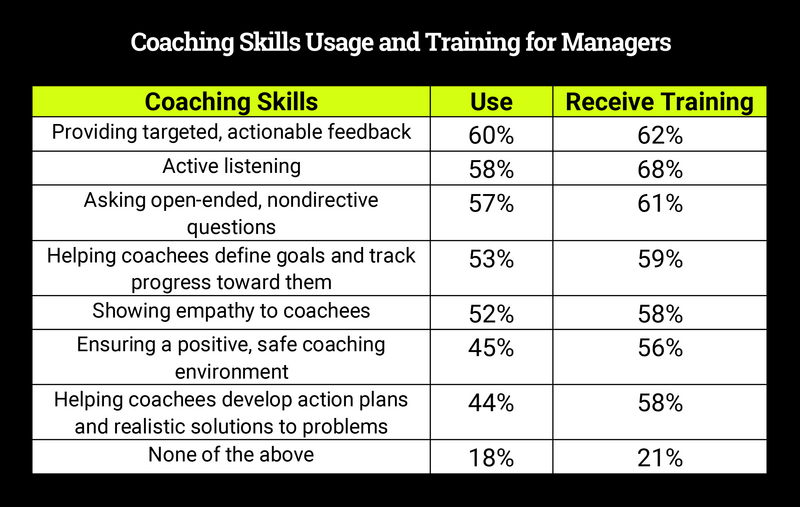
Managers as Coaches findings support the experts’ insights. The report identifies seven critical coaching skills. Of those, two—helping coachees develop their own action plans and solutions; and ensuring a positive, safe coaching environment—are capabilities that managers are least likely to receive training on.
Managers as Coaches findings support the experts’ insights. The report identifies seven critical coaching skills. Of those, two—helping coachees develop their own action plans and solutions; and ensuring a positive, safe coaching environment—are capabilities that managers are least likely to receive training on.
Content
And while training managers on any of the seven skills has a statistically significant connection to better organizational performance, implying the connections would likely appear again if the study were repeated, training on those two skills made the greatest difference in an organization’s probability of being a high performer.
And while training managers on any of the seven skills has a statistically significant connection to better organizational performance, implying the connections would likely appear again if the study were repeated, training on those two skills made the greatest difference in an organization’s probability of being a high performer.
Content
It’s clear from the data that employers should prioritize those two skills in manager training if they want to realize the benefits of a coaching culture. They can start by covering them in a mandatory training course early in each manager’s tenure.
It’s clear from the data that employers should prioritize those two skills in manager training if they want to realize the benefits of a coaching culture. They can start by covering them in a mandatory training course early in each manager’s tenure.
Content
The report also found that when organizations required all managers (internally promoted and externally hired) to undergo coaching skills training within six months of starting to manage others, they were significantly more likely to be high performers than those that did not.
The report also found that when organizations required all managers (internally promoted and externally hired) to undergo coaching skills training within six months of starting to manage others, they were significantly more likely to be high performers than those that did not.
Content
Source: Managers as Coaches: Boosting Employee and Organizational Performance , Association for Talent Development, 2020
Source: Managers as Coaches: Boosting Employee and Organizational Performance, Association for Talent Development, 2020
Content
Read more from CTDO magazine : Essential talent development content for C-suite leaders.
Read more from CTDO magazine: Essential talent development content for C-suite leaders.